
Cryptography and Information Security (CIS) Seminars
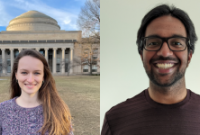 |
Two-Server Private Information Retrieval in Sublinear Time and Quasilinear Space Friday, November 21, 2025 - 10:30am to 12:00pm In this talk, we build two-server private information retrieval (PIR) that achieves information-theoretic security and strong double-efficiency guarantees. |
 |
Efficiently Batching Unambiguous Interactive Proofs Friday, November 7, 2025 - 10:30am to 12:00pm We show that if a language $\mathcal{L}$ admits a public-coin unambiguous interactive proof (UIP) with round complexity $\ell$, where $a$ bits are communicated per round, then the \emph{batch language} $\mathcal{L}^{\otimes k}$, i.e. |
 |
Gödel in Cryptography: Zero-Knowledge for NP With No Interaction, No Setup, and Perfect Soundness Friday, October 24, 2025 - 10:30am to 12:00pm |
 |
Parallel Repetition for Post-Quantum Arguments Friday, October 17, 2025 - 10:30am to 12:00pm We show that parallel repetition of public-coin interactive arguments reduces the soundness error at an exponential rate even in the post-quantum setting. |
 |
The Sponge is Quantum Indifferentiable Friday, October 10, 2025 - 10:30am to 12:00pm |
 |
Succinct Non-interactive Arguments of Proximity Friday, September 26, 2025 - 10:30am to 12:00pm We study succinct non-interactive arguments of proximity (SNAP), which allow a prover to convince a verifier that a statement is true through a short message. |
 |
How to Verify Any (Reasonable) Distribution Property: Computationally Sound Argument Systems for Distributions Friday, September 19, 2025 - 10:30am to 12:00pm As statistical analyses become increasingly central, there is a growing need to ensure their results are correct. Approximate correctness can be verified by replicating the entire analysis, but can we verify without replication? |
 |
Succinct Witness Encryption for Batch Languages and Applications Friday, September 12, 2025 - 10:30am to 12:00pm |
 |
Side Channel Attacks: Lessons Learned or Troubles Ahead? Monday, December 9, 2024 - 4:00pm to 6:00pm The security and architecture communities will remember the past five years as the era of side channels. Starting from Spectre and Meltdown, time and again we have seen how basic performance-improving features can be exploited to violate fundamental security guarantees. |
 |
Perpetual Encryption Friday, August 16, 2024 - 10:30am to 12:00pm We consider the problem of building a private blockchain (BC) on top of a public one. This has the advantage that users of the private BC do not need to build expensive consensus protocol, while still maintaining privacy. |
 |
Post-quantum secure signature schemes from isogenies Friday, July 19, 2024 - 10:30am to 12:00pm Most public-key cryptography that is deployed in today’s systems is susceptible to attacks by quantum computers. |
 |
Indistinguishability Obfuscation from Bilinear Maps and LPN Variants Friday, September 27, 2024 - 10:30am to 12:00pm We construct an indistinguishability obfuscation (IO) scheme from the sub-exponential hardness of the decisional linear problem on bilinear groups together with two variants of the learning parity with noise (LPN) problem, namely large-field LPN and (binary-field) sparse |
 |
Universal SNARGs for NP from Proofs of Completeness Friday, May 17, 2024 - 10:30am to 12:00pm We construct a succinct non-interactive argument system (SNARG) for any NP language L, and prove the non-adaptive soundness assuming the security of an FHE scheme, a batch argument (BARG) scheme, as well as the existence of any two-message argument system for L where the |
 |
How to Construct Quantum FHE, Generically Friday, May 3, 2024 - 10:30am to 12:00pm We construct a (compact) quantum fully homomorphic encryption (QFHE) scheme starting from any (classical) fully homomorphic encryption scheme (with decryption in NC^1) together with a dual-mode trapdoor claw-free function family. |
 |
On Succinct Arguments from Ideal Hash Functions Friday, May 31, 2024 - 10:30am to 12:00pm Note: Non-standard location (P |
 |
Lattice-Based SNARKs: Publicly Verifiable, Preprocessing, and Recursively Composable Friday, April 5, 2024 - 10:30am to 12:00pm A succinct non-interactive argument of knowledge (SNARK) allows a prover to produce a short proof that certifies the veracity of a certain NP-statement. |
 |
Learning from Nisan's natural proofs Friday, March 22, 2024 - 10:30am to 12:00pm |
 |
Adaptively Sound Zero-Knowledge SNARKs for UP Friday, March 15, 2024 - 10:30am to 12:00pm Abstract: |
 |
Unconditionally secure quantum commitments with preprocessing Friday, February 16, 2024 - 10:30am to 12:00pm Abstract: We demonstrate how to build computationally secure commitment schemes wi |
